


08/10/2026
What “Smart” Actually Means for Your Air Conditioner
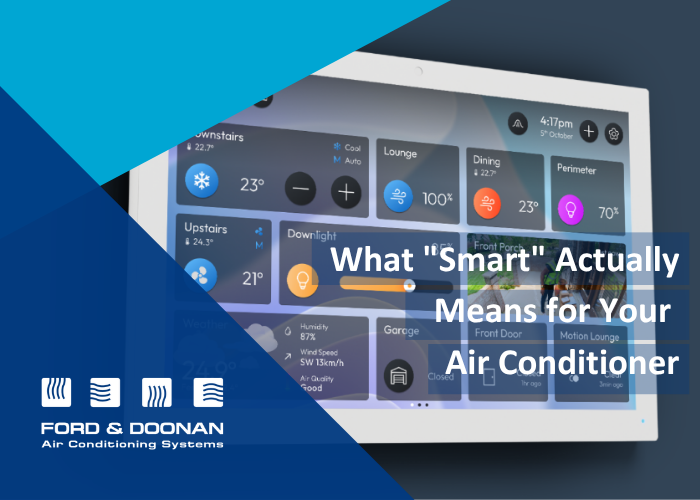
Schedules, sensors, geofencing, app control what do these features actually do, and is any of it more than just a gimmick?
“Smart” gets attached to a lot of home products these days, often as a way of saying “has an app” more than anything more meaningful, and it’s a fair thing to be sceptical of. Strip away the marketing language, and a smart air conditioning system is one that can respond to more information than a basic timer ever could.
That extra information might be a room-by-room temperature sensor, a phone’s location relative to home, a simple schedule built around when the household is usually in and out, or some combination of all three feeding into how the system decides what to do next. None of it is about making a home colder than a basic system already could. It’s about making the decision of when and where to cool less blunt than a single timer switch has ever been able to manage.

The useful part
The practical benefit of smart air conditioning becomes clear in the ordinary, slightly annoying situations that a basic system cannot always handle well.
With AirTouch smart controls, you can create schedules that adjust to the way your household actually operates. That can be useful when school holidays change your usual routine, or when different family members are home at different times.
AirTouch also allows you to control your system and individual zones from a wall console or smartphone app. Rather than cooling the entire house, you can direct airflow to the rooms being used and reduce conditioning in unoccupied areas.
With compatible AirTouch 5 setups, GeoFence technology can provide another layer of automation. When connected to a user’s location, the system can respond when household members leave or return to the property, helping avoid running the air conditioner unnecessarily when nobody is home, while making it easier to return the home to a comfortable temperature before you arrive.
Smart controls can also provide temperature alerts, helping you stay informed if conditions in the home move outside your preferred range. This may be useful for monitoring comfort, checking that a system is operating as expected or receiving an alert when a room becomes warmer or cooler than planned.
It’s worth saying plainly: none of this is about making a home colder for its own sake, and smart controls will not turn a poorly performing home into a well-performing one. Their value is in helping the air conditioner respond more intelligently to how a household lives—matching operation to occupancy, location and time of day rather than treating every room and every hour identically.
That is a useful improvement. It is simply a more practical and modest benefit than the word “smart” can sometimes imply.
NEXT IN THIS SERIES: The House Itself Still Does Most of the Work
 1800 AIR CON
